
The complete guide
How to Choose a Grain Free Dry Cat Food That Your Cat Will Actually Eat
The problem with the cat food aisle
Standing in front of a wall of cat food is a strange experience. Every bag looks confident. Every bag has a picture of a cat who appears thoroughly satisfied with its life choices. Meanwhile, the cat at home has opinions it will not share, and the only feedback you ever get is a bowl that is either empty or untouched.
The honest answer is that there is no single best grain free cat food for every animal. Cats differ in taste, in size, in how active they are, and in what their vet has advised. What you can do is narrow the field sensibly, pick something that suits the life stage and size of your cat, and then introduce it properly so you are actually testing the food rather than testing your cat's patience.
This guide walks through how dry food works, who a grain free recipe tends to suit, how to read a label without getting lost, and how to store a 2.5kg bag so the last handful is as good as the first.
What dry food actually is
Dry cat food is kibble. The ingredients are mixed, cooked, shaped and dried down to a low moisture level, which is what gives it a long cupboard life and its particular crunch. Fats and palatants are usually applied toward the end, because that outer coating is a big part of what makes a cat lean into the bowl.
The practical advantages are easy to list. You can portion it in a few seconds, it does not need refrigerating once the bag is open, and it does not spoil in the bowl on a warm afternoon the way wet food will. If you free-feed, or if someone else looks after the cat while you are away, dry food is far less fuss.
The trade-off is moisture. Dry food contains very little of it, so fresh water needs to be available all the time, in a clean bowl, changed daily. Some cats drink readily. Others are casual about it and do better with a wide bowl or a tap-style fountain. That is worth noticing in your own household.
Where grain free fits in
Grain free simply means the recipe is built without grains such as wheat, corn or rice. Other carbohydrate sources, usually vegetable starches and vegetable meals, take their place. It is a formulation choice, not a medical claim, and plenty of excellent foods contain grains.
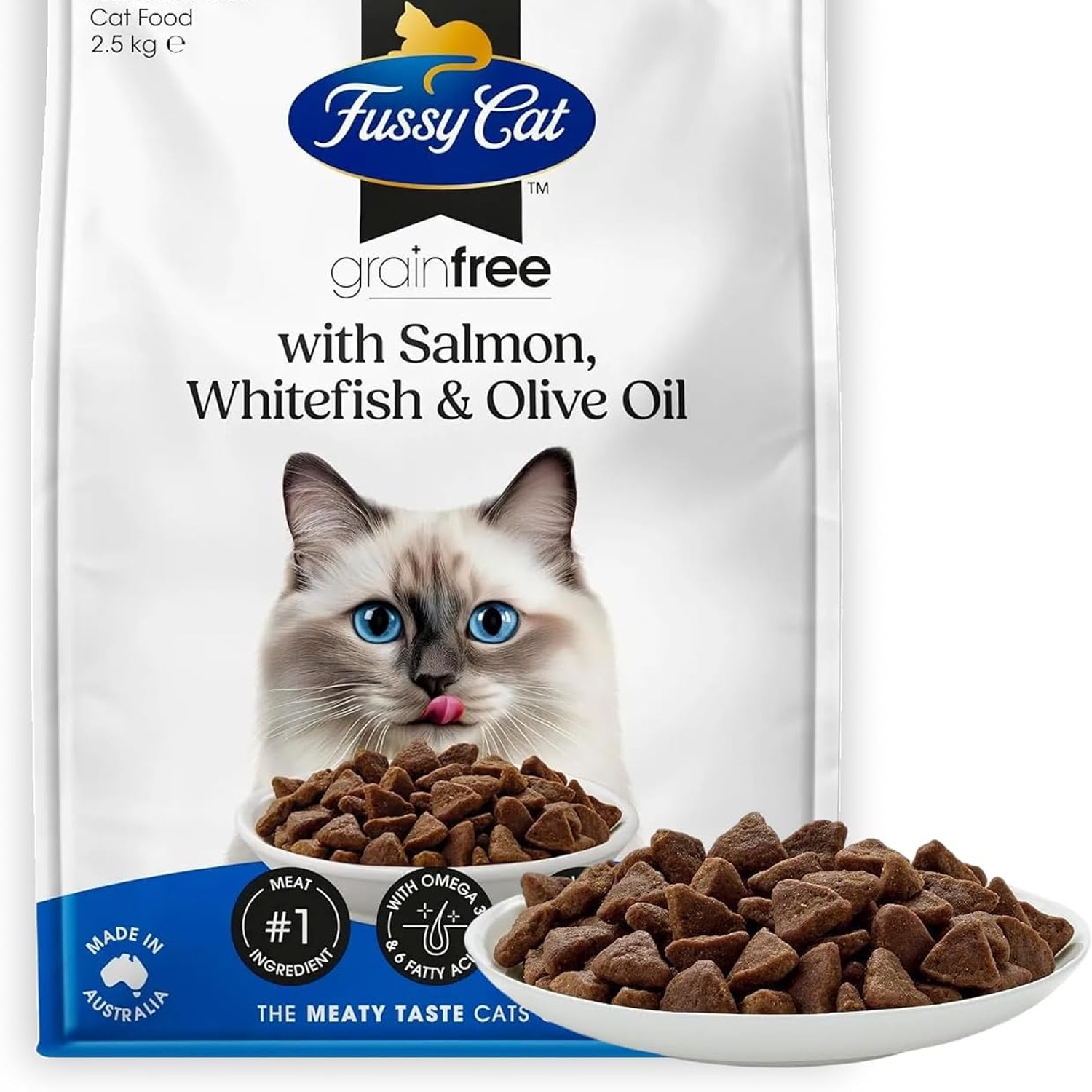
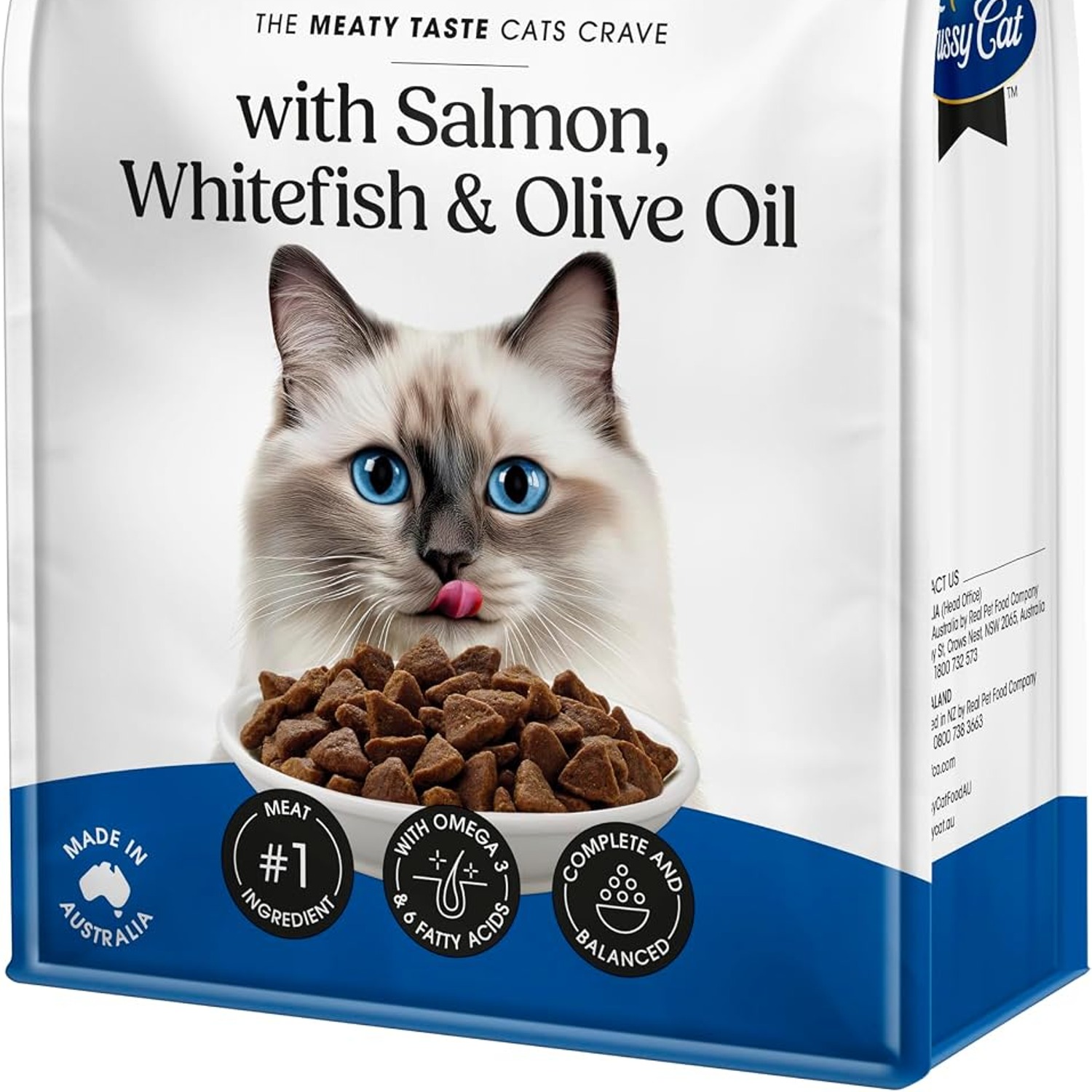
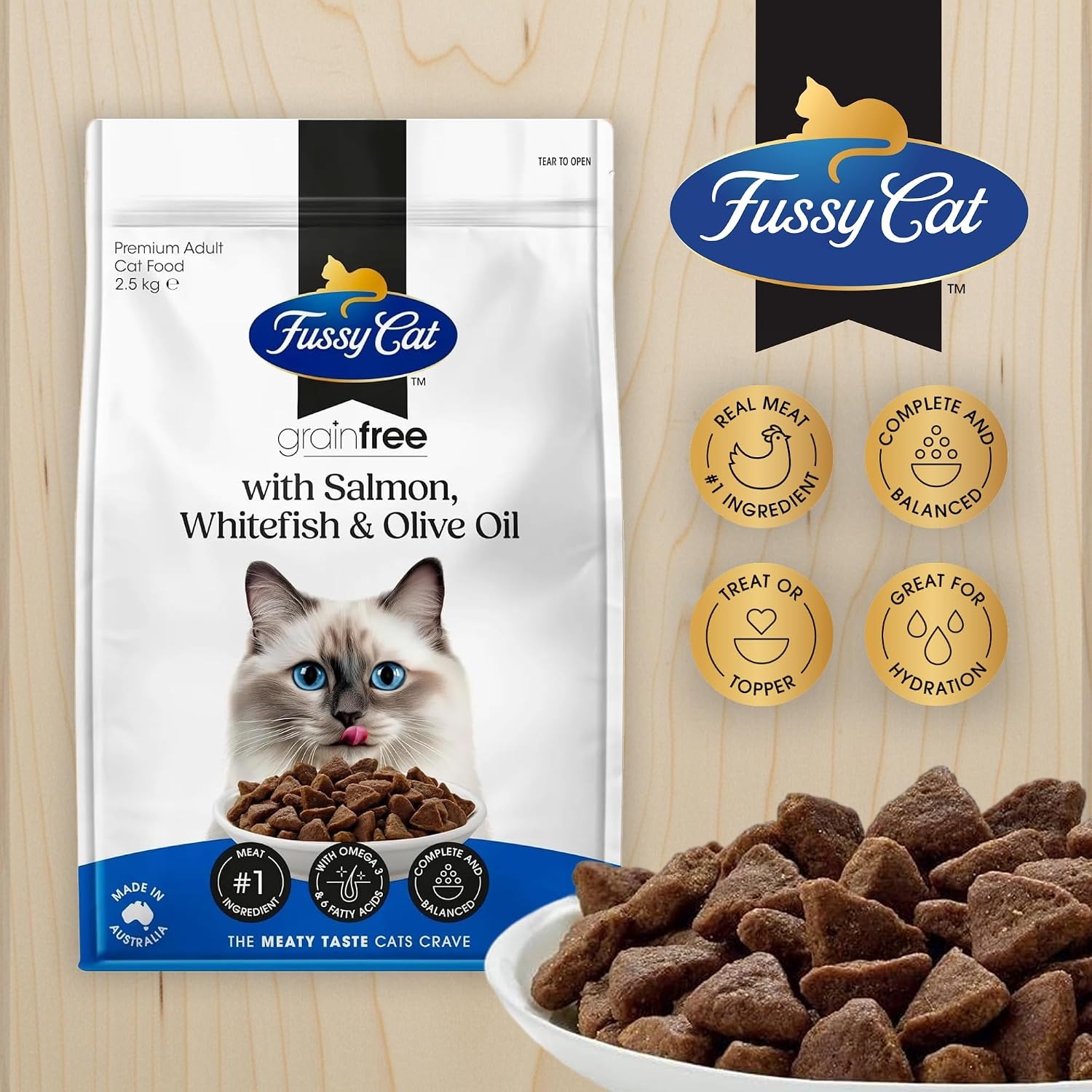
People choose grain free for different reasons. Some have been advised by their vet. Some have a cat who did not get along with a previous food and want to try a different approach. Some simply prefer a shorter, more focused ingredient list. The Fussy Cat Grain Free Salmon, Whitefish and Olive Oil recipe is listed by the maker as grain-free with a limited ingredient diet type, and names salmon, whitefish and olive oil as its special ingredients.
If you are considering grain free because of a suspected food sensitivity, talk to your vet first. Working out what a cat reacts to is a methodical process, and guessing at it in the supermarket aisle rarely gets anywhere.
Reading the label without the headache
Ingredient panels on pet food are written to a standard format, and they take a minute to decode. On this product the panel starts with meat meals and meat by-products (poultry, fish and beef) and/or poultry by-product meal, then moves through vegetable meals and vegetables, vegetable starches, tallows, palatants, vegetable pulp, oils including olive and fish, oilseeds, salt, potassium chloride, cellulose fibre, choline chloride, methionine, taurine, dried chicory root, vitamins and minerals, yucca schidigera extract and a natural antioxidant.
Two things are worth pointing out. Taurine appears by name, and it is a nutrient cats cannot make enough of themselves, so you want to see it listed. The "and/or" phrasing in the meat section is standard industry wording that allows the maker some flexibility in sourcing between batches.
If anyone in your household has a reason to avoid a specific ingredient, read the panel on the physical pack when it arrives rather than relying on any online description, including this one. Packaging is the definitive source.
Who this bag suits
The maker lists the life stage as adult and the breed recommendation as all breed sizes. That makes it an everyday food for a grown cat rather than a kitten formula or a senior formula. If your cat is still growing, or is well into its later years, or is managing a health condition, your vet is the right person to ask about what the bowl should contain.
Size-wise, 2.5kg hits a sensible middle. For a single cat it typically lasts long enough that reordering does not become a chore, while still being small enough to finish before freshness becomes a question. Households with several cats may prefer to keep two bags on the go, using them in order of the best-before date printed on each pack.
The fish flavour matters too. Cats are driven heavily by smell, and fish recipes often appeal to animals who turn their nose up at poultry. If you have been hunting for the best salmon cat food for a picky eater, a fish-led recipe is a reasonable place to begin, though taste remains individual.
Making the switch properly
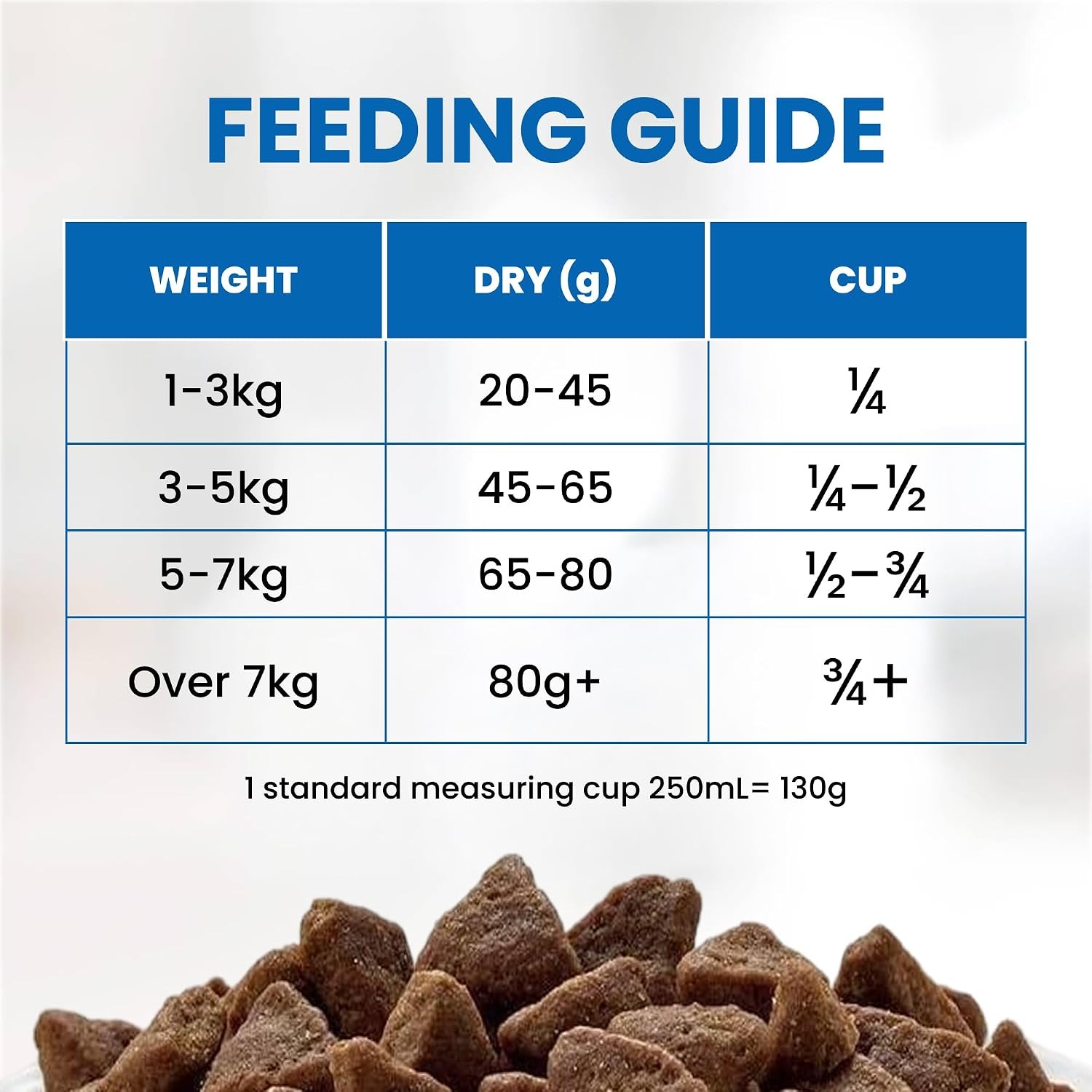
This is the part most people rush, and it is the part that decides whether the food gets a fair trial. The maker's feeding guide is direct about it. Mix increasing amounts of the new food while decreasing the old food over a period of five to seven days.
A simple version looks like this. Days one and two, roughly a quarter new food. Days three and four, about half. Days five and six, three quarters. Day seven, all new. If your cat hesitates, slow down and hold at a ratio for an extra day or two rather than pushing on.
Portions themselves come from the feeding guide on the pack. The maker states plainly that the amounts shown are a guide only and that your cat may need more or less depending on age, breed and activity level. An indoor cat who sleeps for eighteen hours a day has different needs to one who patrols the back fence. Keep an eye on body condition over a few weeks and adjust from there, or ask your vet for a target.
Storage, bowls and the boring bits
Kibble is tough but not indestructible. Air, warmth and light all work against it, mostly by affecting the fats in that outer coating. Keep the bag somewhere cool and dry, away from direct sun, and roll or clip the top closed after every use.
If you decant into a container, keep the original bag. It carries the batch details and the best-before date, both of which you would want if you ever needed to ask a question about a particular pack. A lot of people find the simplest system is to drop the whole sealed bag inside a larger tub rather than tipping the kibble out loose.
Wash the food bowl regularly with hot soapy water. Oils from kibble build up on the surface over time, and a cat with a good nose will notice a stale bowl long before you do. Keep the water bowl separate and refresh it every day.
The short version
Pick a food that matches your cat's life stage and breed size, read the ingredient panel on the actual pack, and follow the feeding guide rather than guessing at portions. Introduce any new bag over five to seven days by mixing it with the old one, and give your cat time to decide.
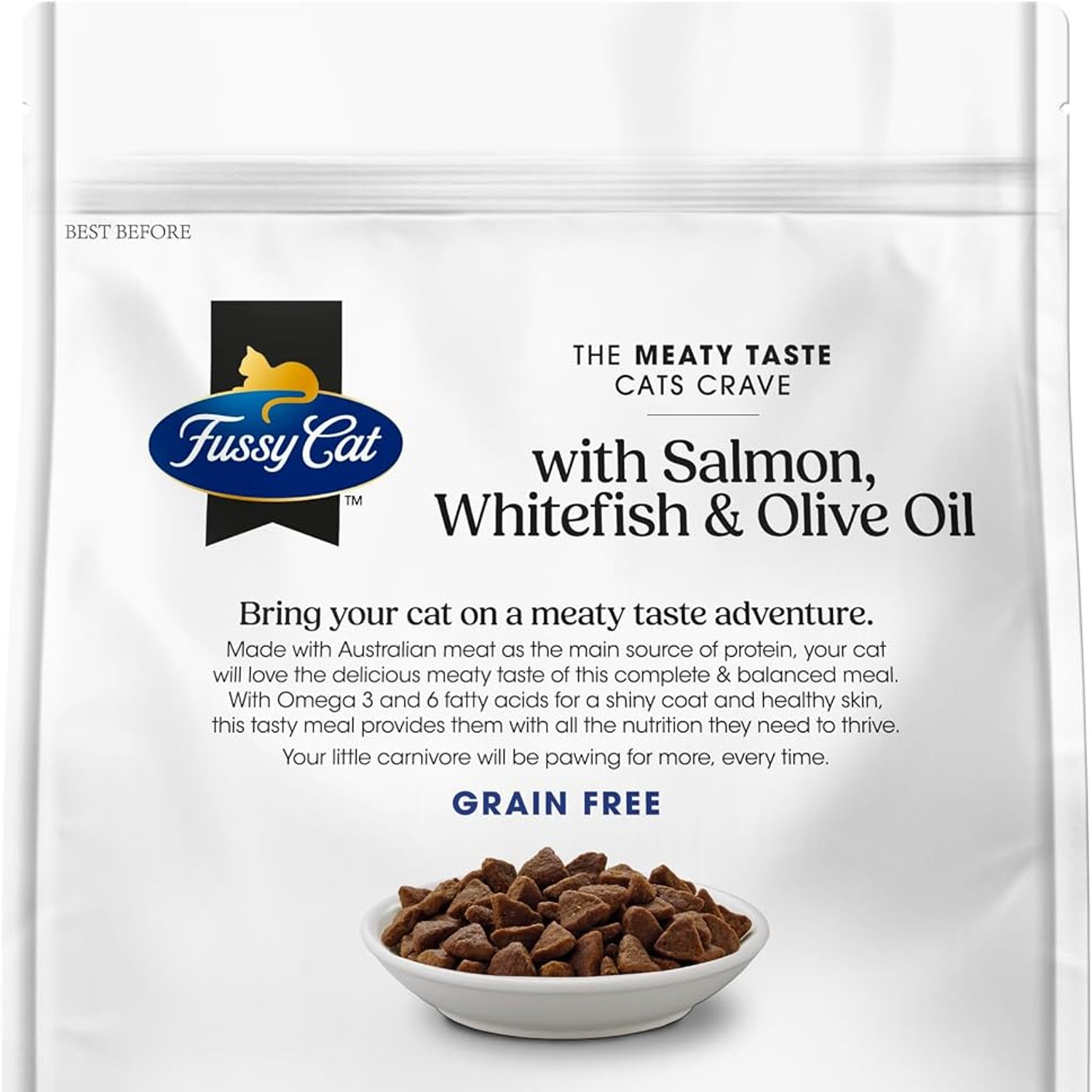
This particular product is a 2.5kg bag of grain free dry kibble for adult cats of all breed sizes, with salmon, whitefish and olive oil as its named flavour and special ingredients, made by Pets Global, Inc. Store it sealed, keep fresh water available, and check the best-before date printed on the pack. For anything to do with allergies, digestion or your cat's health, your vet is the right call.